
 Available in US
Content

The league where favourites win least often
The SHL sits at the bottom of the twelve major hockey leagues ranked by favourite win rate, with favourites taking approximately 59.04% of matches across recent samples. That’s the lowest favourite rate of any major hockey league — the closest comparable major league is the NHL at 61.93%, nearly three percentage points higher. The structural implication is simple: SHL produces more upsets than any other major hockey league, and the underdog markets carry the most frequent positive expected value in the global hockey market.
For UK punters, the SHL also offers the cleanest time-zone fit of any non-British league. Sweden is GMT+1 (CET), one hour ahead of UK winter time. SHL evening matches at 19:00 local start at 18:00 UK time. That’s the post-work betting window for most UK punters, ahead of NHL puck drops at 11pm-1am and well-aligned with the UK leisure calendar. The combination of upset-rich market structure and convenient timing makes SHL the under-rated value engine for UK hockey punters.
Why SHL has the most upsets
The 59.04% favourite win rate doesn’t happen by accident. Three structural features of the SHL push favourites toward lower win rates than other major hockey leagues.
First, the talent distribution is flatter. The SHL operates with a salary cap and tight financial regulation, which prevents the kind of payroll concentration that produces dominant top tiers in leagues like the KHL or even the NHL. Frölunda, Skellefteå AIK, Färjestad BK, HV71 — the SHL’s traditional powers — operate within roughly the same budget range as the league’s mid-tier and lower-tier clubs. The structural ceiling on roster spending means the SHL’s “top team” advantage over its “bottom team” is smaller in payroll terms than in any major hockey league.

Second, the league depth across positions is unusually balanced. Swedish player development has produced consistent supply of top-quality wings, defencemen, and goaltenders across the league’s clubs. The two-pair defensive depth that decides tight matches doesn’t concentrate in the top three or four clubs — it spreads across the league. A nominal underdog facing a nominal favourite in the SHL has access to comparable defensive structure, which suppresses the favourite’s expected goal differential.
Third, the playoff push pattern produces variance through the season. SHL teams in the middle of the table push hard for playoff qualification across the final third of the regular season, generating upset wins against top-table clubs that have already secured their playoff position. The market doesn’t fully price the late-season motivation differential, leaving underdog moneylines at +180 to +230 (implied 30-36%) winning at 33-40% in the qualifying subset.
The contrast with the leagues at the top of the favourite-win-rate rankings (three Ligue Magnus clubs from France lead the list) is instructive. Ligue Magnus has a wider talent gap between top clubs and bottom clubs because of fewer financial controls and a narrower player pool. The same gap reverses in the SHL, where balanced controls and deep player development produce the upset-rich market the league is known for.
UK time-zone fit, in detail
SHL match times are concentrated in the European evening — 19:00 to 19:30 local across most match days. With Sweden at GMT+1, those start times translate to 18:00-18:30 UK time. By the time the average UK punter is home from work, the SHL match is in the first or second period, and live betting markets are active and liquid.
The pattern across the week: SHL plays heaviest on Tuesday, Thursday, and Saturday nights, with lighter Wednesday and Friday slates. The Saturday afternoon matches at 15:00-16:00 local (14:00-15:00 UK) overlap with English Premier League football for many UK punters, which is a competing-attention factor. The Tuesday and Thursday evening matches are the cleanest slots — minimal competing UK sport, dedicated post-work betting window, and concentrated SHL coverage from UK-licensed operators.

The implication for line-shopping: the European market window for SHL prices opens roughly four hours before puck drop. UK operators typically post their lines around 14:00 UK time on match days, with the European sharp money window between 14:00 and 18:00. Lines move during this window as European punters and Swedish punters with on-ground information adjust prices. UK punters watching the line in the 14:00-15:00 window can take pre-movement prices on selections that European sharp money will subsequently push toward.
Underdog moneyline strategy in SHL
The 59.04% favourite win rate means underdogs win 40.96% of SHL matches. That’s a substantially higher underdog hit rate than any other major hockey league. The implication for moneyline strategy: SHL underdogs at +170 to +220 have implied probabilities of 31-37%, against actual hit rates of 38-44% across the broader sample. The 5-7 percentage point gap is durable across the regular season.
The narrower subset where the value is sharpest: road underdogs at +180 to +220 against home favourites priced shorter than -200. The implied probability of those underdogs is 31-36%, against actual rates of 36-42%. The mechanism is partly the structural upset rate and partly the over-pricing of heavy home favourites in a league where heavy favouritism is rare. When the market does price a clear favourite, the corresponding underdog price often runs longer than the actual probability supports.

The flat-staking approach to SHL underdog moneylines: stake 1 unit on every qualifying underdog (priced +180 to +250, against an opponent with significant pre-game favouritism) and accept the variance. A long-run sample of 200+ qualifying bets has historically produced ROI in the +3% to +7% range, which is among the cleanest structural edges in the global hockey market.
The trap to avoid: aggressive parlay construction. SHL underdogs winning at 40% rates tempt punters into 2-leg and 3-leg parlays at attractive cumulative prices. The math works against this — two independent 40% events parlay to a 16% chance of both hitting, while operators typically pay 14-15% implied (decimal 6.50-7.00). The single-leg approach captures the structural edge without compounding the operator juice.
SHL totals and the low-scoring bias
SHL matches average 5.0-5.3 goals per game across recent seasons. That’s lower than the NHL average of 6.1 in the post-audit era and well below the IIHF Worlds averages of 5.8-5.83 per match. The Swedish league plays a more structured, defensive style than the NHL or the IIHF tournament environment, which suppresses scoring across the season.
The 5.5 total line at -110 has historically hit Under at 55-58% across recent SHL seasons, against an implied 52-54%. That’s a structural Under bias the market reflects partially. The 5.0 total line at -130 to -140 implies 56-58% Under hit rate; actual rate runs 60-63%. The 5.0 Under is the cleaner play when operators offer it, but the line isn’t universally available across UK-licensed operators — some books offer only the 5.5 line.

The team total markets follow similar patterns. SHL home favourites with team total 2.5 over at -130 historically hit at 53-56%, against an implied 56-58%. That’s a slight fade. The team total 2.5 over at -120 implies 55%; actual rate is 53-56%. Approximately fair value, with marginal value cases on specific matchups where the home favourite faces a weak penalty kill against their top power-play unit.
The under-priced SHL totals bet is the 1.5 in second-period markets. The long-change effect that produces elevated second-period scoring in the NHL doesn’t transfer cleanly to the SHL — Swedish defensive structures are tighter, and the second-period elevation is smaller (about 6-8% above first-period rate, versus 10-15% in the NHL). The second-period 1.5 Over at -110 implies 52% but hits at only 48-51% in SHL matches. The slight Under skew makes the second-period 1.5 Under at +100 a credible take on tight defensive matchups.
Which UK books cover SHL
UK coverage of the SHL is more uneven than NHL or KHL coverage. Tier-one UK-licensed operators (bet365, Sky Bet) typically carry SHL moneyline and totals across most regular-season fixtures, with thinner prop markets and limited puck-line availability. Mid-tier UK operators sometimes carry only top-table SHL fixtures, leaving mid-table matches without published lines.
The line-shopping opportunity in the SHL is substantial because of the thinner coverage. Discrepancies between licensed operators of 0.20-0.40 decimal odds are common on SHL underdogs — one operator might offer +200 on a road dog while another offers +185 on the same selection. That 0.15 decimal-odds gap is meaningful CLV for the punter taking the longer price.
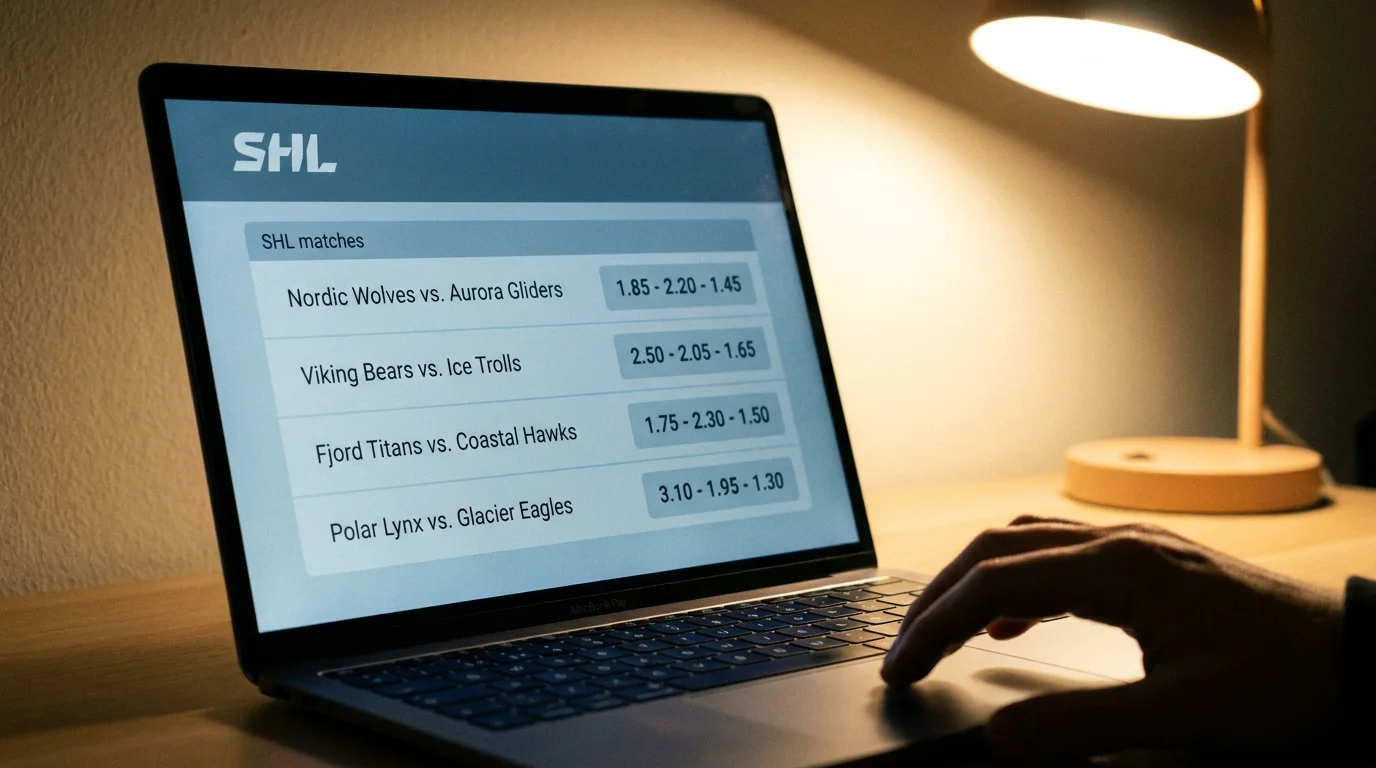
The other practical pattern: SHL line movement is sharpest in the 4-hour pre-match window when European sharp money is active. UK operators that take a passive approach to line management — opening at a model price and not adjusting until significant action arrives — tend to leave longer-priced underdogs available for longer than the European market peers. That’s a timing advantage for UK punters who track the European market consensus through European odds-comparison platforms before placing UK-side bets. The broader context of how SHL clubs perform in cross-league competitions sits in the related piece on SHL clubs in the Champions Hockey League, where the cross-league favouritism patterns get a fuller treatment.
Frequently asked questions
Two questions UK punters ask about SHL markets come up regularly. Both touch the upset-rich structure and the timing fit.

Why does the SHL have the lowest favourite win rate among major hockey leagues?
Three structural features push SHL favourites to the lowest win rate among the twelve major hockey leagues at 59.04%. First, the salary cap and financial regulation prevent payroll concentration, so the SHL’s top teams operate within roughly the same budget range as mid-tier clubs. The structural ceiling on spending keeps the favourite-underdog gap smaller than any other major league. Second, Swedish player development produces deep talent across positions, with comparable defensive structures available to nominal underdogs. Third, the playoff push pattern across the final third of the regular season produces late-season upsets when mid-table clubs push for qualification against top-table clubs that have already secured spots. The combination produces consistent value on SHL underdog moneylines.
What’s the typical UK kick-off time for SHL matches?
SHL matches are concentrated in the European evening, with start times of 19:00-19:30 local. Sweden is GMT+1 (CET), one hour ahead of UK winter time, so puck drop is typically 18:00-18:30 UK time. That’s the post-work betting window for most UK punters, ahead of NHL match starts and well aligned with the UK leisure calendar. Saturday afternoon SHL matches at 15:00-16:00 local (14:00-15:00 UK) overlap with English football for many punters. Tuesday and Thursday evening matches are the cleanest UK time slots with minimal competing British sport, dedicated post-work attention, and concentrated SHL coverage from UK-licensed operators including bet365 and Sky Bet.
